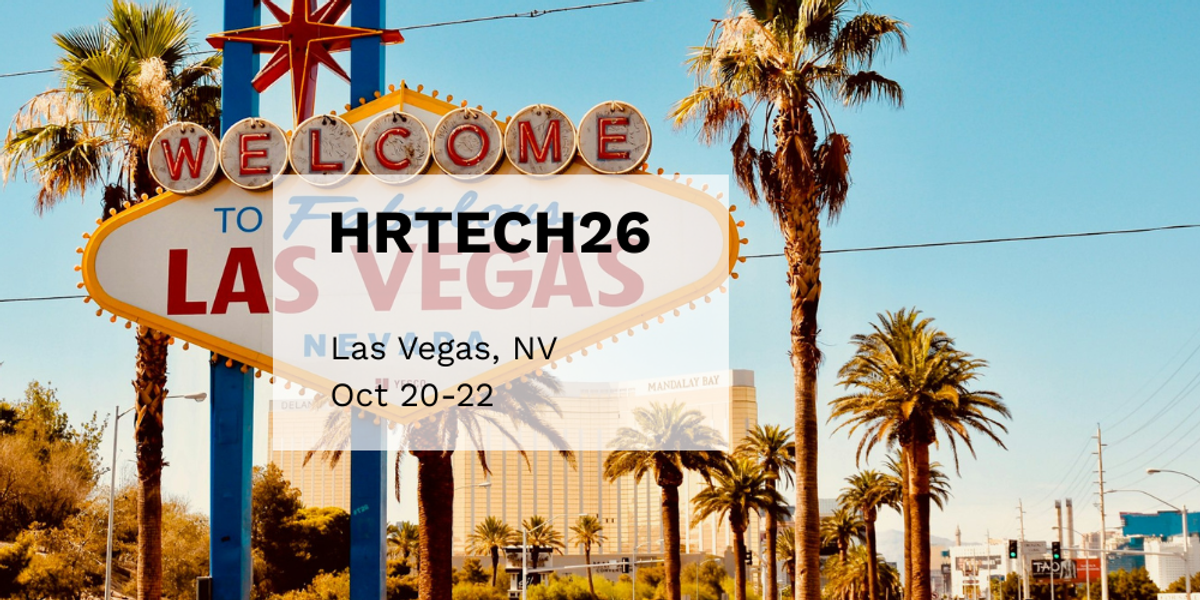
HR Technology Conference 2026 is the largest dedicated HR tech event in the world, returning to Mandalay Bay in Las Vegas from October 20 to 22. The show brings together close to ten thousand HR leaders, HRIT professionals, talent acquisition teams, and roughly five hundred technology providers for three days of sessions, networking, and an enormous expo floor. If you are weighing whether to attend, what to attend, or how to get the most out of the week, this guide covers what to expect, who it serves, what is genuinely new in 2026, and how to plan a trip that actually pays back. It is written for first-time attendees, returning veterans, and the HR leaders who keep getting asked by their teams whether it is worth the flight.
What is the HR Technology Conference?
The HR Technology Conference and Exposition is the flagship event of the HR technology industry in the United States. It has run annually since 1997 and is produced by Human Resource Executive. Over nearly three decades, it has grown from a small gathering of HRIS practitioners into the central market moment of the HR software year. If you spend any part of your career evaluating, buying, building, selling, or operating HR technology, HR Tech is the room where that work is publicly discussed.
The conference draws CHROs, VPs of HR, HRIS and HRIT leaders, talent acquisition directors, learning and development leaders, total rewards leaders, people analytics leaders, and the analysts, advisors, system integrators, and vendor teams who serve them. It also draws a meaningful number of HR practitioners one or two levels below the executive line, including HRIT managers, recruiting operations leads, compensation analysts, and learning systems administrators. That mix matters because so much of the value sits in cross-role conversations. The room where a CHRO is debating an HRIS replatform is usually the same room where the HRIT manager who will actually run the migration is also taking notes.
HR Tech sits at the intersection of HR strategy and software buying. Sessions cover talent acquisition technology, core HRIS and payroll, learning platforms, employee experience, total rewards tech, HR analytics, AI in HR, and the operational realities of running a modern people function. The expo floor is the largest HR tech show floor in the country, with established platforms, mid-market vendors, and a fast-growing AI-native cohort. For HR tech buyers, the conference is where short lists get built. Most major HR software decisions inside US enterprises run through evaluations that include vendor conversations from HR Tech.
The conference is intentionally different in tone from a general HR event. Sessions are practical, often technical, and skew toward case studies, demos, and analyst commentary rather than motivational keynotes. The expo floor is loud and dense, with vendor demos running back to back, and most product launches in the category are timed to land during conference week. If you have ever wondered why so many HR software press releases drop in October, this is the reason.
When and where is HR Tech 2026?
HR Technology Conference 2026 takes place October 20 to 22, 2026, at the Mandalay Bay Convention Center in Las Vegas. Mandalay Bay sits at the south end of the Las Vegas Strip and hosts the full program of sessions, expo, and evening events under one roof. The convention center is connected to the hotel by a covered walkway, which matters in October when daytime highs can still hit the mid-eighties. Discounted hotel blocks at Mandalay Bay and partner properties open in spring 2026 and historically sell out within weeks.
Mandalay Bay is served by Harry Reid International Airport, roughly fifteen minutes away by ride share, longer at peak hours. Most attendees fly in Monday and out Thursday morning. Some stretch the trip with a Tuesday evening arrival or a Friday departure, especially if they are attending the Women in HR Tech Summit on Tuesday morning or one of the late evening receptions on Thursday. Sessions begin Tuesday and run through Thursday, with the expo floor open the middle two days, typically Tuesday afternoon through Thursday afternoon. Pre-conference workshops and partner events run on Monday for attendees who want a deeper dive before the main program.
Weather in Las Vegas during the third week of October is usually mild. Daytime temperatures hover in the upper seventies to mid-eighties, with cool evenings dropping to the fifties. Most attendees pack one layer for evening events and otherwise dress business casual. The convention center floor is heavily air conditioned, so a light jacket or blazer is useful even when the outside temperature suggests otherwise.
For attendees flying in from the east coast or central time zones, plan for the three-hour or two-hour time difference. Many east coast attendees arrive Sunday night to recover before Tuesday's opening, especially if they are presenting or running booth duty.
Who attends HR Tech?
The HR Tech attendee base spans the full HR function and includes a sizeable contingent from outside HR proper.
CHROs and VPs of HR attend in meaningful numbers, particularly from mid-market and enterprise organizations actively evaluating major platform shifts. Many CHROs come specifically to validate vendor decisions their teams are already running, to take in analyst content on where the market is heading, and to spend time with peer CHROs from non-competing companies. CHRO peer conversations at HR Tech are often more candid than at general HR events because the audience is smaller and the topics are narrower.
HRIS and HRIT directors and managers, the technical owners of the HR stack, are heavily represented. For this group, HR Tech is a working week. They are evaluating integrations, comparing data models, watching demos with hard technical questions, and meeting with their current vendors' product teams in dedicated rooms. Many HRIT leaders book their full Tuesday and Wednesday with twenty to thirty minute one-on-ones, leaving Thursday for sessions and the expo.
Talent acquisition leaders and directors of recruiting come to compare AI sourcing, candidate experience, conversational AI, scheduling automation, interview intelligence, and ATS-adjacent tools. The TA buyer profile has shifted noticeably over the last three years. What used to be a search for the best single ATS has become a search for the right combination of an ATS, a sourcing layer, a candidate experience layer, and increasingly an AI agent layer that sits across all of them.
Learning and development leaders attend in smaller but visible numbers. The L&D track has grown as AI features in learning platforms have moved from nice-to-have to expected. Total rewards leaders attend in pockets, mostly to evaluate compensation benchmarking tools, equity administration platforms, and the new wave of pay equity analytics tools. People analytics leaders show up for the analytics track and the unstructured data sessions, which have become some of the most attended in the program. DEI leaders attend in modest numbers, often joining for the Women in HR Tech Summit and specific sessions on bias auditing and workforce data ethics.
Around five hundred technology providers exhibit each year, ranging from the largest HCM platforms to early-stage AI startups. The exhibitor mix has shifted noticeably toward AI-native vendors over the last three years, though the established platforms still anchor the largest booths. The analyst community is well represented. Josh Bersin Company, Sapient Insights, RedThread Research, Aptitude Research, Brandon Hall Group, and 3Sixty Insights all run sessions and host meetings during the week. Practitioners outnumber executives on the floor, which is part of why the conversations tend to land harder than at general HR conferences. You are more likely to hear a practitioner say "that demo would not actually work for us" than a polite executive nod.
If you are wondering whether you would feel out of place, the answer for almost any HR-adjacent role is no. The crowd is genuinely mixed. You will see CHROs in suits, HRIT engineers in conference T-shirts, recruiters carrying tote bags full of vendor swag, and startup founders working laptops at the Mandalay Bay coffee bars between meetings.
What is new at HR Tech 2026
The 2026 program includes more than two hundred sessions across the major HR tech categories. Three storylines are likely to dominate.
First, AI agents in HR. The shift from "AI features inside HR products" to "AI agents that operate alongside HR teams" is well underway, and 2026 will surface the first wave of production deployments rather than vendor pitches. Expect more case study sessions, fewer vendor product pitches dressed as keynotes, and more honest discussion of what works and what does not. The early production data from companies that have run AI agents inside recruiting, employee help desks, and HR shared services for twelve to twenty four months will be one of the most useful threads of the week. Buyers should pay attention to the volume metrics, the human review rate, the escalation patterns, and the candid commentary on where agents broke down.
Second, recruiting and TA technology consolidation. The space has been crowded for years and 2026 is when the market starts to differentiate between tools that meaningfully shorten the recruiter workday and tools that simply add another tab. Several large vendors are expected to announce major consolidation moves, either through acquisition, product convergence, or simplified packaging. The buyer conversation has moved from "what is the latest sourcing tool" to "what is the smallest possible recruiting stack that still moves the needle on time to fill and candidate quality."
Third, governance and trust. AI governance, candidate data privacy, bias auditing, and explainability have moved from compliance-team agenda items to CHRO agenda items. The legal landscape is moving fast, with state-level AI hiring laws expanding and federal guidance evolving. Expect a meaningful number of sessions on practical governance approaches, model cards for HR AI, vendor audit rights, and what to put in a contract addendum. The mood is no longer "should we use AI" but "how do we use it responsibly and prove that we are doing so."
Beyond the three big themes, watch for new program highlights. The inaugural HR Icons Awards Evening recognizes individuals and teams shaping the field. The Women in HR Tech Summit returns as a dedicated track with the 2026 theme "Be the Change." Pitchfest, the live startup competition, continues to anchor the most-watched startup moment on the show floor. The Top HR Tech Products awards are announced during the main program. The HR Tech Spotlight stage, a smaller venue for live demos and rapid-fire vendor presentations, has expanded for 2026. Several analyst firms are also expected to publish their annual HR tech state-of-the-market reports during conference week, with the reports themselves becoming a small ecosystem of paid and free deliverables you can collect on the floor.
Should you go to HR Tech 2026?
Three buyer profiles get the clearest return on the trip.
The first is anyone actively evaluating HR tech this year. If your team is shortlisting a new HRIS, ATS, learning platform, AI agent, analytics tool, or any other significant piece of the stack, three days at HR Tech compresses what would otherwise be months of vendor calls into a single concentrated window. Most enterprise buyers walk out with their short list narrowed, expanded, or completely rewritten. The savings in calendar time alone usually justify the cost of attendance. If you arrive prepared, with specific problems written down, you can run fifteen to twenty meaningful vendor conversations in three days, which would otherwise stretch across two quarters.
The second is HR and HRIT leaders not actively buying but responsible for the long-term tech roadmap. The value here is the analyst content, the peer hallway track, and early visibility into where the HR tech market is heading. Even teams locked into long-term contracts often find that one or two sessions reshape their internal AI strategy for the next twelve months. The roadmap value tends to come from unexpected sessions. The talk you skip because the title sounds soft is often the one that lands hardest because it reframes a category you thought you understood.
The third is anyone whose career sits inside HR technology specifically. HRIS analysts, TA tech owners, HR ops leads, consultants, advisors, and product managers at HR tech vendors fall in this bucket. The peer network at HR Tech is the field's most concentrated community of practice, and most regulars say the hallway conversations are worth the trip on their own. Many career moves and consulting engagements get sourced here, in part because the field is small enough that one good conversation per day across three days can meaningfully expand a personal network in a single trip.
There is a fourth, less obvious profile that benefits: HR leaders responsible for change management who are not buying anything new this year. The value for that profile is exposure to how peer organizations are handling the human side of HR tech change. Several sessions on adoption, training, and rollout playbooks are useful even if your stack is stable.
If none of those describe you, the answer is probably no. SHRM Annual is a better choice for HR generalists who want broad coverage of HR practice. Talent50, the LinkedIn Talent Connect ecosystem, and Recruiting Brainfood events serve recruiters who want depth on sourcing and TA practice without the platform-buying lens. Workhuman Live or similar events better serve culture and recognition leaders. ATD International or Learning Technologies serve L&D leaders who want deeper practice content. Each of these communities has its own rhythm, and HR Tech is not a one-size-fits-all replacement.
What sessions and tracks should you plan around?
The HR Tech program runs across multiple parallel tracks. Most attendees underplan day one, overplan day two, and run out of energy by day three. A good rule is to pick one anchor session per morning and one per afternoon, and leave the rest of the time for the expo, hallway conversations, and unplanned vendor meetings. The biggest mistake first-timers make is treating the agenda like a college course catalog. Pick less, attend more deeply, and protect time for the parts of the conference that are not on the schedule.
The tracks worth scanning carefully when the agenda publishes:
The Talent Acquisition track for recruiters and TA leaders. Expect strong content on AI sourcing, recruiter productivity, candidate experience metrics, and the post-AI hiring funnel. Watch for sessions led by TA leaders at companies that have already run AI agents in production. Their numbers tend to be more credible than the vendor numbers.
The HR Tech Talks main stage for the keynote-style sessions and analyst presentations. The main stage runs the most-watched sessions of the week and is where the analyst firms anchor their state-of-the-market reports. Showing up early for main stage sessions is worth it because seating fills quickly and the back of the room makes follow-up conversations harder.
The HRIS and Core HR track for HRIT and HRIS leaders. This track is where the actual technical content sits. Sessions on data models, integration platforms, payroll modernization, and HRIS replatform case studies belong on every HRIT leader's calendar. The Q&A portions are often more useful than the prepared content.
The Learning and Talent Development track for L&D leaders. The L&D track has steadily grown as AI has reshaped content authoring, skill inference, and adaptive learning paths. Watch for sessions on skills frameworks, AI tutors, and the operating model implications of AI in workforce development.
The People Analytics track for analytics teams. The most useful sessions tend to be the practitioner ones rather than the vendor ones. Look for sessions that walk through a specific business question, the data work required to answer it, and the operational outcome.
The AI in HR track, which has expanded significantly each of the last three years and is the largest track in 2026. Within AI in HR, the sessions split roughly into three buckets: vendor briefings, practitioner case studies, and governance content. The case studies are the highest-signal of the three, especially when the case study includes a frank discussion of what did not work.
The Women in HR Tech Summit runs as a dedicated half-day on Tuesday. It draws one of the largest single-session crowds of the week and consistently ranks among the highest-rated parts of the program. The summit has become a meaningful career touchpoint for women in HR technology and is worth attending regardless of seniority.
Pitchfest and the Top HR Tech Products session are the two highest-signal moments on the show floor. Both surface vendors most attendees would not have found through their own evaluation process. Many enterprise buyers add a Pitchfest finalist to their next quarter shortlist purely based on the on-stage performance.
A few practical session tips. Read session abstracts carefully and treat speaker affiliation as a signal. Sessions delivered by a vendor are usually product-led. Sessions delivered by a practitioner who happens to use a vendor's product are usually more useful. Sessions delivered by an analyst are usually mixed, with the most informative ones being state-of-the-market overviews. Save the panel sessions for energy-low slots because panels are forgiving of split attention.
What awards and special events should you not miss?
The inaugural HR Icons Awards Evening is the headline addition for 2026. The event recognizes individuals and teams whose work has shaped the field, and the format will likely settle in as one of the marquee evenings of the week. Even if you are not a nominee or attending in support of a colleague, the evening is a useful proxy for which leaders, practitioners, and teams are setting the field's tone right now.
The Women in HR Tech Summit, themed "Be the Change" for 2026, opens the conference and draws one of the largest single-session crowds of the week. The summit has grown into a marquee program within the program and is worth attending regardless of role or seniority.
The Top HR Tech Products awards are announced during the main program and have become one of the most reliable signals of which products the industry views as breaking through. Buyers often use the Top Products list as a starting point for vendor research after the conference, and inclusion has become a meaningful signal in the field. The award short list is published in advance, and reading it before the conference is one of the highest leverage prep tasks you can do.
Pitchfest, the live startup competition, draws an enthusiastic crowd and often produces the most quoted moments of the conference. Even if you are not in a buying cycle, Pitchfest is a useful read on where category innovation is heading. Most attendees find the room worth a sixty to ninety minute investment.
Evening receptions, sponsored dinners, and after-hours gatherings cluster around the Mandalay Bay property and nearby Strip hotels. Most attendees find that two evening events per night is the realistic ceiling. The best evening events are the smaller, vendor-hosted dinners that gather ten to twenty buyers in a single category, because the conversations are real and the time is contained. The larger receptions are useful for networking volume but tend to be noisy and shallow.
A short list of evenings worth planning for: the official welcome reception on the expo floor on Tuesday evening, the HR Icons Awards Evening, the Women in HR Tech Summit reception, and the closing party on Thursday night. Outside of those, fill in with the dinners and receptions that match your role.
Logistics: travel, hotels, registration, food
Hotel blocks at Mandalay Bay and partner properties open in spring 2026. The Mandalay Bay block typically sells out first because of how convenient it is for the convention center. Nearby Strip hotels including Delano, Luxor, Excalibur, and Park MGM are within walking distance or one Tram stop away. Properties farther up the Strip, such as Bellagio, Cosmopolitan, MGM Grand, and Aria, are accessible by ride share in ten to twenty minutes, longer at peak hours. A short walk through the Mandalay Bay casino and across the Tram bridge will save twenty minutes on a typical evening if you are staying at one of the partner properties.
Registration tiers vary by package and timing. Early-bird passes typically run several hundred dollars below standard passes, with bundled hotel and registration options available through the official HR Tech site. Practitioner discounts and group rates are offered for HR teams attending together. Final pricing for 2026 is published on the official site, hrtechnologyconference.com. If your team is sending three or more attendees, the group rate is usually worth a call to the HR Tech registration line. There is typically an expo-only pass for buyers who only want to walk the floor, though sessions are excluded.
Most attendees recommend arriving the evening of Monday, October 19, to settle in before Tuesday's opening sessions, and flying out Thursday afternoon or Friday morning if you want a full third day on the floor. East coast attendees often add Sunday night to recover from the time change.
Food at and around Mandalay Bay deserves a paragraph of its own. The convention center has decent on-site options but they get crowded fast. Most attendees plan two anchor restaurants and accept that lunches are likely a coffee and a protein bar between sessions. Reserve dinners well in advance because the Strip restaurants fill up during HR Tech week. Mandalay Bay has solid in-house options, and the food court at the south end of the Strip is faster than fighting the crowds farther up. For coffee meetings, the Mandalay Bay coffee bars near the conference entrance are the easiest option, though they get a line in the morning. The Starbucks inside Mandalay Bay is usually faster than the cafes inside the convention center proper.
Connectivity is generally good at Mandalay Bay. The conference Wi-Fi works in most session rooms but can slow during heavy expo hours. Bring a portable battery for your phone and a longer charging cable. If you are taking notes on a laptop, expect to be hunting for outlets during sessions. Many attendees switch to a tablet or notes app on phone for the expo floor portion of the day.
How to prepare in the weeks before the conference
A short prep playbook for first-time and returning attendees alike.
Four to six weeks out. Book travel, register early-bird, and reserve the Mandalay Bay hotel block as soon as it opens. Begin a simple internal doc with your top three to five problems you want to make progress on at the conference, written in plain language. Share it with your team and ask for their additions.
Three to four weeks out. Scan the agenda for must-attend sessions and add them to a separate calendar. Identify the vendors you want to meet on the floor and reach out through their website or your account contact to book on-floor meetings. Most vendor calendars fill up by Friday before conference week. Reach out to two or three peer practitioners you respect and offer to grab a coffee on Wednesday between sessions.
Two weeks out. Confirm hotel, transportation, and any pre-conference workshop registrations. Pre-read the analyst firm reports if any are published before the conference. Read the Top HR Tech Products award short list when it is announced. Write your "what good looks like" list for any active vendor evaluations and bring it printed or on your phone.
One week out. Finalize your daily plan. Block out one morning anchor session and one afternoon anchor session per day. Block out one full hour for the expo floor each day. Leave the rest of the time for unplanned vendor meetings, peer conversations, and recovery. Brief your team on what you intend to bring back.
Day of departure. Pack a light layer for evening events. Pack a portable battery for your phone. Bring a small stack of business cards even though many attendees use the conference app. Bring a notebook or note-taking device with a comfortable typing setup. Charge everything before you land.
What to do during each of the three days
Each day of HR Tech has a different rhythm. Plan accordingly.
Day one, Tuesday. The morning is usually slower as people arrive, register, and orient. The Women in HR Tech Summit runs in the morning and is one of the strongest opening sessions of the week. Use the afternoon for the expo floor's opening, which is high energy and a useful first sweep of the booths. Avoid trying to schedule heavy meetings on Tuesday afternoon because energy tends to be uneven. Tuesday evening receptions are good for casual networking before the harder schedule of Wednesday.
Day two, Wednesday. The most content-dense day. Main stage sessions, the major track breakouts, the Top HR Tech Products session, and the most active expo hours all land on Wednesday. Most attendees find Wednesday the highest-value day of the conference and accept that they will be tired by evening. Pace your morning, take a real lunch break if possible, and protect a thirty minute recovery slot in the afternoon. Wednesday evening usually has the most vendor-hosted dinners.
Day three, Thursday. Energy is lower across the board. The expo floor is quieter, attendance is thinner, and several attendees leave by mid-afternoon. Thursday is good for the deeper sessions, the follow-up vendor conversations, and the closing program. If you have specific people you wanted to meet but did not catch on Tuesday or Wednesday, Thursday is your second chance because schedules are more open. The closing party in the evening is a useful low-stakes networking moment.
How to follow up after the conference
The week after. Send specific follow-up notes to the three to five people who mattered most. A short, specific note that references your conversation is far better than a generic LinkedIn connection request. Pull the analyst reports you collected and triage them by relevance. Schedule a one hour internal debrief with your team to share notes.
Two weeks after. Convert vendor conversations into either a next step or a polite close. Most vendors will follow up aggressively, and a clean "yes, schedule a deeper demo" or "no, we are not in market this year" is better for everyone than letting the thread drift. Update your team's shortlist with the new information from the conference.
Four weeks after. Reread your top three takeaways and decide which ones become commitments. The risk after every conference is that the energy fades and nothing changes in the next quarter. Most teams find that picking one to two changes and actually shipping them is far more valuable than trying to action ten.
Frequently asked questions
Is HR Tech 2026 worth attending if my company is not actively buying HR software?
For most HR leaders, yes. The analyst content, the peer hallway track, and the early visibility into where the HR tech market is heading are valuable even when you are not in a buying cycle. Teams running locked-in long-term contracts with their HRIS or ATS often find that one or two sessions reshape their internal AI strategy for the next twelve months. The expo floor is also one of the few places to see live demos of newer tools without committing to a vendor sales cycle. If your team is running a stable platform but you sense the AI landscape is shifting, the cost of attending is small compared to the cost of being two years late on a category change.
How is HR Tech different from SHRM Annual?
SHRM Annual is the largest general HR conference in the US, with a much broader audience covering all of HR. HR Tech is the largest HR technology-specific conference, with deeper sessions and exhibitor focus on software, data, and AI. SHRM attracts HR generalists and people leaders across all industries. HR Tech attracts the buyers and operators of HR software specifically. Most enterprise HR teams send different people to each conference, with overlap mainly at the CHRO and VP level. The shorthand: SHRM is about HR practice, HR Tech is about HR software. If you are choosing one, choose the one that matches the work you are doing this year.
What is the best way to evaluate AI HR tech vendors at the conference?
The most useful evaluation move is to bring two or three real, named problems from your current workflow and ask vendors to show how their product handles those specific cases. Generic demos are designed to impress. A specific workflow walkthrough exposes whether the vendor has built the product for your reality or for a marketing reel. The second move is to ask, directly, where employee or candidate data lives, where AI inference happens, what models are used, what the audit trail looks like, and how the vendor handles data deletion. Vendors who answer cleanly are usually further along on governance than those who pivot to feature talk. The third move is to ask for one current customer reference in your industry and size. A vendor who can offer that reference within twenty four hours is usually a more mature partner than one who hesitates.
What questions should I ask vendors about AI on the floor?
A short, useful list. Where does the model run, and is data leaving our environment? What models are powering the agentic behavior, and how are they updated? What happens when the AI is wrong, who is accountable, and what is the human review rate? What are the typical implementation timelines for a customer of our size? Can we see the actual usage logs from a current customer rather than a demo environment? What is your roadmap for the next twelve months and what changes if we sign before year end? Which integrations are first party and which are third party? Vendors who answer these calmly and specifically are usually further along than vendors who pivot to feature talk.
Can I attend just the expo or do I need a full conference pass?
Most years, HR Tech offers an expo-only pass that grants exhibit hall access without admission to keynote or breakout sessions. The expo-only pass is a reasonable option for buyers who only want to walk the floor and meet vendors, though many attendees find that one or two sessions repay the price of an upgrade. Confirm 2026 expo-only availability on the official registration page before you book. The expo-only pass is also a useful option for HR practitioners whose travel budget is tight but whose vendor evaluation work is real.
How much does it cost to attend HR Tech 2026?
Registration tiers vary by package and timing. Early-bird passes typically run several hundred dollars below standard passes. Practitioner discounts and group rates are available for HR teams attending together. Final pricing for 2026 is published on the official HR Technology Conference site. Total trip costs typically include the conference pass, flight, hotel for three to four nights, meals, and ground transportation. Many attendees budget between two thousand and four thousand dollars total, depending on travel costs and how many evenings are covered by vendor-hosted dinners.
Where should I stay for HR Tech 2026?
Mandalay Bay is the most convenient option because the convention center, expo floor, and most evening events are on property. Nearby Strip hotels including Delano, Luxor, Excalibur, and Park MGM are within walking distance or one Tram stop away. If you want a quieter evening or are extending your stay, properties farther up the Strip are accessible by ride share in ten to twenty minutes. Hotel blocks open in spring 2026, and the Mandalay Bay block sells out first. If you miss the Mandalay Bay block, Delano is the next-closest option and is connected to Mandalay Bay by an indoor walkway.
How do I plan my sessions without burning out by day three?
Most veterans recommend picking one anchor session per morning and one per afternoon, and leaving the rest of the time for the expo, hallway conversations, and unplanned vendor meetings. Trying to attend every session in your track is the fastest way to be exhausted by Wednesday afternoon. Build in at least one full hour on the expo floor each day, and protect a meal slot for unscripted peer conversations. Drink more water than feels necessary, plan light dinners, and accept that one missed session is not the end of the world.
How do I get on the calendar of vendors I want to meet at HR Tech?
Reach out two to three weeks in advance through the vendor's website, conference contact form, or your existing account team. Specify your role, your team size, and one or two specific problems you want the meeting to address. Vendors prioritize prepared buyers with named problems over generic "want to see a demo" requests. Booking on-floor demos in advance is also smart because the most in-demand booths fill up by Tuesday morning. If a vendor is on your serious shortlist, a thirty minute private room meeting is usually more valuable than a ten minute booth conversation. Most large vendors offer private meeting rooms adjacent to the expo floor.
What is Pitchfest and is it worth attending?
Pitchfest is HR Tech's live startup competition, where early-stage HR tech companies pitch a panel of judges and the audience. It is one of the most reliable ways to find emerging vendors before they are on every shortlist. Even if you are not in a buying cycle, Pitchfest is a useful read on where category innovation is heading. Most attendees find the room worth a sixty to ninety minute investment. The post-Pitchfest hallway is where the most useful introductions happen, often with the founders themselves still backstage and the investors mixing with buyers in the crowd.
What are the Top HR Tech Products awards?
The Top HR Tech Products awards recognize the most innovative products in the HR technology category each year. The list is curated by the HR Tech program team and announced during the main program. Buyers often use the Top Products list as a starting point for vendor research after the conference, and inclusion has become a meaningful signal in the field. The short list is published in advance and is one of the most useful pre-reads for the week. Read the list, pick the categories that match your problems, and book meetings with those vendors before you fly out.
Can I bring my whole team?
Yes, and many enterprise HR teams do. Group rates are available, and most teams split coverage across tracks so they can compare notes during meals. A common pattern: the HRIT leader covers core HRIS and analytics sessions, the TA director covers the recruiting track, the L&D lead covers the learning track, and the CHRO covers the main stage and analyst sessions. End-of-day team debriefs are how the trip actually pays back. The team that walks back into the office with a written one-page summary of what each person heard is the team that captures the most value.
When does the 2026 agenda get published?
The HR Tech program publishes in stages through the summer ahead of the conference. Keynotes and main stage sessions usually appear first, followed by breakouts and the Women in HR Tech Summit lineup. Check the official site, hrtechnologyconference.com, for the most current version once you have registered. The mobile app launches a few weeks before the conference and is the easiest way to build a personal schedule. Update your schedule the Friday before the conference because last minute speaker changes are common.
Should I download the HR Tech mobile app?
Yes. The HR Tech app is the easiest way to navigate sessions, search exhibitors, build your personal schedule, and message peers. Download and log in the weekend before the conference. Build your schedule before you board your flight, because the Wi-Fi at the airports and at Mandalay Bay can be uneven during peak times. The app also includes the floor map, which is faster than walking the expo blind.
How do I justify the trip internally?
A short internal one-pager works best. Describe two to three specific outcomes the trip will deliver, name the sessions and vendor meetings that support those outcomes, and pre-commit to a one-hour team debrief on the Monday after the conference. Most managers approve when they see specific outcomes rather than a general "I want to attend HR Tech." If you are early in your HR tech career, frame the trip as concentrated learning equivalent to a quarter of online study time, plus a network effect that cannot be replicated remotely.
Is HR Tech a good place to look for a new HR tech job?
Yes, though not in the way many conferences are. There is no formal job board at the event. The hiring conversations happen in hallway exchanges, evening receptions, and after Pitchfest. Most HR tech vendors are quietly hiring throughout the year, and a strong conference conversation often becomes an interview the following month. If you are exploring, prepare a short version of your background, what you are looking for, and the kind of company you want to be inside. People help when the ask is specific.
How do I make HR Tech worthwhile for a first-time attendee?
Three rules. First, read the agenda before you arrive and build a draft schedule rather than walking in cold. Second, spend more time on the expo floor than you think you should, because the highest-signal conversations of the week are often unscheduled. Third, do not skip the evening events on Tuesday and Wednesday because the network effect compounds across days. If you talk to no one on Tuesday, your Wednesday and Thursday will feel lonely. Add a fourth rule if you can: introduce yourself to one new person in every session you attend.
How do introverts get the most out of HR Tech?
Plan smaller, scheduled conversations rather than relying on random networking. Block one-on-ones in advance with the people you most want to meet. Choose smaller breakouts over main stage sessions when you have the choice, because the rooms are more conversational. Take real breaks. Walk outside between sessions when the weather allows. The pace of HR Tech is not optimized for quieter attendees by default, but a well-planned schedule of focused conversations beats a chaotic week of receptions.
What is the best way to capture notes during the conference?
Pick one note-taking system and use it consistently across all three days. A simple template helps: session title and speaker, three key insights, one quote worth keeping, one action to take. For vendor meetings, capture the vendor name, the three specific use cases discussed, and one named follow-up. Doing this in real time is much more useful than trying to reconstruct it on the flight home. If you have a team attending, agree on a shared notes doc structure before you fly so the debrief is easy.
What is the experience like for vendors and exhibitors?
For vendors, HR Tech is the most important week of the year for pipeline. Booth design, demo scripting, and pre-conference outreach all matter. The best-performing vendor teams set explicit meeting targets per rep, book most of those meetings in advance, and run a tight booth schedule. For first-time exhibitors, expect to learn how the floor works in real time and to refine your approach for the second year. The expo floor is not a place to wait for buyers to come to you; the best vendor teams are actively pulling traffic into their booths through scheduled meetings, demo sessions, and well-targeted swag.
How has HR Tech changed in the last five years?
Three big shifts. First, AI has moved from a side track to the dominant theme across the entire program. Second, the buyer mix has shifted toward smaller, faster-moving evaluation teams that include HRIT and operations leaders alongside the traditional CHRO. Third, the vendor mix now includes a meaningful cohort of AI-native startups that did not exist five years ago, alongside the established HCM platforms that still anchor the expo. The pace of the conference has also picked up, with more session formats running in parallel and more vendor activations on the floor.
What should I avoid at HR Tech?
A short list. Avoid back-to-back vendor meetings without breaks because your tenth meeting will not get your best attention. Avoid scheduling anything past 10 p.m. because the next morning will hurt. Avoid the temptation to attend every flashy session at the expense of the deeper breakouts. Avoid vendor swag you will never use because your carry-on will fill up. Avoid making major decisions on the floor; bring the information home and decide with your team after a real night's sleep.
Are there any free or discounted options for practitioners?
HR Tech runs practitioner discounts, group rates, and occasional scholarship programs. Check the official site for the most current offers. Some sponsoring vendors also distribute discount codes to qualifying buyers, and analyst firms sometimes share access codes with their client community. If cost is a real barrier, the expo-only pass is the most accessible entry point.
Where can I find HR Tech content after the conference?
Many sessions are recorded and shared with attendees after the event. Analyst firms publish post-conference recaps that summarize the major themes. Several HR podcasts cover the conference in the weeks following. The HR Executive site itself publishes coverage during the week and after. If you missed a session, it is usually findable in some form within a month.
When should I start planning for HR Tech 2027?
Most veterans book travel and the hotel block within sixty days of the prior year's conference because Mandalay Bay sells out fast. If you found 2026 valuable, schedule a quick internal review by mid-November, lock in budget for 2027 by the end of the year, and watch the official site for early-bird registration when it opens.
Final thoughts
HR Technology Conference 2026 is the highest-density week of the year for anyone whose work touches HR software. Whether you are evaluating a major platform shift, mapping a multi-year AI strategy, or just trying to keep your roadmap honest, three days at Mandalay Bay in October will compress a lot of work. The conference rewards preparation. Read the agenda. Reach out to vendors and peers in advance. Set two or three specific outcomes you want to take home and protect time on the schedule to deliver them. Register early for the best rate, book the Mandalay Bay block as soon as it opens, and plan your sessions before you arrive. The teams that get the most out of HR Tech are the ones that treat it as a working trip, not a conference visit.