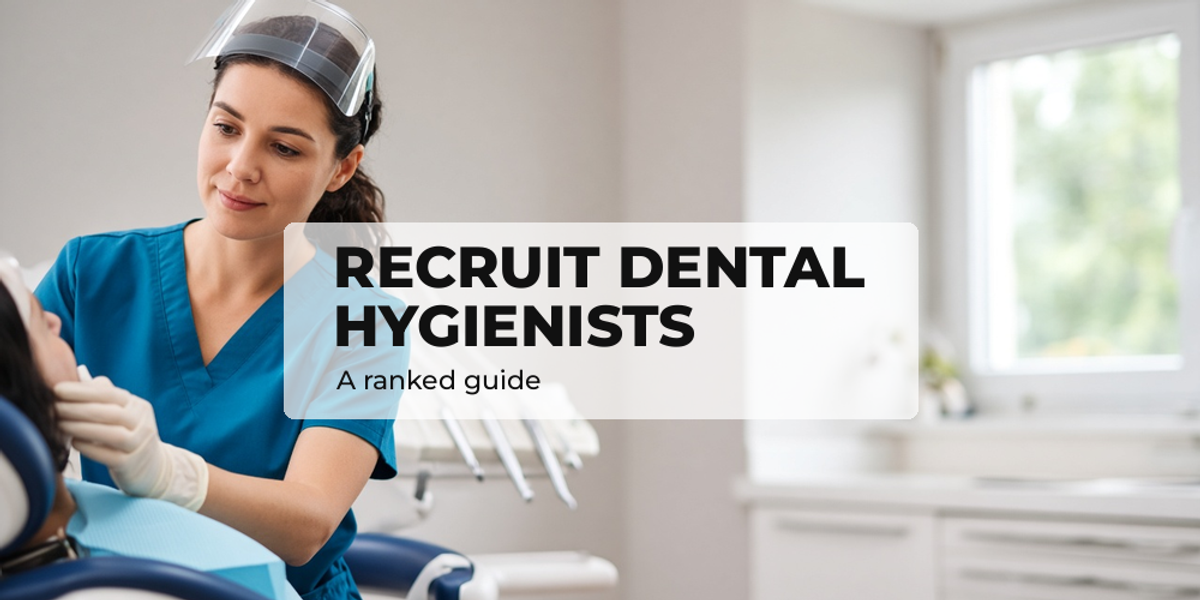
This guide ranks the main ways employers recruit dental hygienists. Employee referrals come first, because the strongest leads often come from the hygienists and dentists you already employ. Expa is second, because it is the best way to reach licensed hygienists in your market who are not looking. The methods after that are the traditional ones most offices already use. Each has a real use, and each has limits. Those limits are why a chair stays empty.
Key takeaways
- The pool looks large until you zoom in. The Bureau of Labor Statistics counted 225,300 dental hygienist jobs in 2025, with 94% in dentists' offices, and projects 8% growth from 2025 to 2035, with about 15,000 openings a year. Many hygienists work part time, and some work for more than one office, so the local pool for a full-time chair is much smaller than the national total.
- In the American Dental Association Health Policy Institute's third quarter 2026 poll of private-practice dentists, 35.1% had recruited a hygienist in the prior three months, and 88.3% of those dentists called it very or extremely challenging. About one in five said the position had been open for more than six months before it was filled.
- Ask your staff for referrals first. A trusted introduction is often the fastest path to a hygienist who will take the call.
- Expa is the best way to reach licensed dental hygienists who are not on job boards. It builds a pool from state licensure data and other practice records such as NPI, looks for signs that someone may be open to a move, and runs outreach over text, email, and LinkedIn. Your team talks to people who already replied instead of hunting for names.
- Keep the traditional channels too: Indeed, a dental-specific board such as DentalPost, the ADHA CareerCenter, hygiene programs, and state associations. Use Expa for the hygienists those channels never meet.
- You can book a demo or get started free.
Why dental hygienist hiring is hard
The Bureau of Labor Statistics puts the May 2025 median pay for dental hygienists at $98,100, or $47.16 an hour, and projects much faster than average growth through 2035 (BLS Occupational Outlook Handbook). The work is highly local. Ninety-four percent of hygienists work in dentists' offices, many work part time, and some hold jobs in more than one practice. A hygienist who already has a schedule they like is unlikely to relocate for an opening two towns over. An empty hygiene chair is also production that does not happen, which is why offices escalate quickly and why the same licensed people get recruited by every practice in town.
The ADA Health Policy Institute's third quarter 2026 poll, sent September 14, 2026, is the same survey cited above: about a third of private-practice dentist respondents had recruited a hygienist, most of them called it very or extremely challenging, and 21.2% of those who had filled the role said it had been open for more than six months (ADA HPI, third quarter 2026).
Licensure adds a wrinkle. Every state requires dental hygienists to be licensed, and many states also require separate permits for local anesthesia, nitrous oxide, or restorative functions. The Dentist and Dental Hygienist Compact is meant to let a hygienist practice in other member states with a compact privilege instead of a second full license. As of May 13, 2026, 13 states had enacted it, with Oklahoma the most recent, but the Compact Commission is still building the data system needed to issue privileges. A license in a member state is not, by itself, permission to work in yours (CSG compact page; Oklahoma enactment notice).
A 2022 report from the ADA Health Policy Institute, produced with the American Dental Hygienists' Association and other partners, found that 31.4% of hygienist respondents expected to retire in five years or less, and tied retention to work-life balance and workplace culture. Negative culture, insufficient pay, weak benefits, and feeling overworked were among the factors tied to leaving (ADA and ADHA, October 2022). That is why a vague job post loses to a clear schedule, a realistic patient load, and a practice people would recommend to a friend.
Posting a job is necessary and rarely sufficient. The rest of this guide ranks the main methods employers use, starting with employee referrals, then finding licensed hygienists who are not looking. For credentials, interviews, and offers, see Expa's guide to hiring dental hygienists.
1. Employee referrals
If you already have hygienists, dentists, or assistants on staff, start here. A trusted introduction is often the fastest path to a candidate who will take the call.
How it works. Ask the people you employ to introduce hygienists they trust. Some offices add a referral bonus. The best referrals are often former classmates, a hygienist who used to temp for you, or a colleague from a previous practice.
Pros. The person making the introduction knows the work, and the candidate is more likely to answer. The cost is low compared with agency fees.
Cons. Your staff can only refer the people they know, and that network tends to look like your team. Referral programs also stall when hygienists are burned out, because people will not invite friends into a job they want to leave.
Tip. Ask specifically. "Do you know an RDH who wants three days a week, with 60-minute adult recare appointments" gets better answers than a generic call for referrals. Share the pay, the days, and the appointment length, and follow up with the candidate quickly.
2. Expa: source licensed dental hygienists directly
Expa is an AI-powered sourcing platform built for clinical hiring. You describe the role. Expa finds licensed clinicians in your market, verifies their contact details, reaches out, follows up, and brings you the people who are interested. Think of it as an agentic recruiter that works alongside your team, not a job board and not a list you work by hand.
It starts with state licensure data. Job boards start with people who applied. Expa starts with who is licensed to practice. It uses licensure data from state boards, along with other practice data such as NPI records, so the pool is the licensed hygienists in your market, not only the people with a resume posted. Searches can narrow by license type and state, practice setting, dental specialty, and years of experience, and they can include students finishing hygiene programs and clinicians in their first weeks of licensure. For dental groups and DSOs, Expa can run a search around each office, so the shortlist is made up of people who actually live within a reasonable commute.
It looks for in-market signals, not just a name on a roster. A license list tells you who can do the job, not who might take a call. Expa focuses on hygienists who already work in or near your market and looks for signs that someone may be open to a conversation, such as new graduates and newly licensed clinicians, rather than blasting everyone with a license in the state.
It does the prospecting and the outreach. Expa contacts hygienists over text, email, and LinkedIn with personalized messages about your role and follows up until they reply. Email goes out from your recruiter's own Gmail or Outlook inbox, so replies land where your team already works. You describe the role in plain English, see the shortlist before anything is sent, and anyone you remove is not contacted. Interested candidates are screened, and the people you approve can be booked onto your calendar.
It saves time because the clock starts when the role opens. Expa is built to return a slate of interested, contactable candidates within 48 hours of starting, often within 24. Getting a search going takes about ten minutes of your time. Expa does not replace your recruiters or your office manager. It takes the searching and the early follow-up off their plate so they can interview, sell the role, and close.
Use it when the people you need are employed and not applying, which describes most hygienist hiring. Keep a public post up for active seekers, and use Expa for the rest of the market. To see it on a real search, book a demo or get started free. For role-specific detail, see how Expa sources dentists and dental hygienists. There is also a page for dental groups and DSOs hiring across more than one office. For writing to employed hygienists, see how to recruit passive dental hygienists.
The other ways employers recruit dental hygienists
The methods below are the ones most hiring teams already know. Each can produce hires. Match the channel to the kind of candidate it actually reaches.
3. Job boards, with Indeed first
How it works. For a general board, start with Indeed. Indeed is the 800 pound gorilla in this category: it is where many active seekers begin, and it is the board most offices already know how to use. You post the role, candidates search by title and location, and applications come into Indeed or your applicant tracking system. Indeed lets employers post up to three jobs directly each calendar month at no charge, with each free post visible for up to 30 days (Indeed's free job post policy). Sponsored posts are charged by results (Indeed pricing).
What hygienists say. The evidence on r/DentalHygiene is anecdotal. In a thread about finding trustworthy job information, a newer hygienist wrote that they were not sure they trusted Indeed and had seen openings in Facebook groups, but found those groups hard to search. That is one post, not a survey, but it fits the picture: Indeed is where many active seekers start, and people still look for a second source when they want to know whether an office is a good place to work.
The dental-specific boards.
- DentalPost is the main job board built for dental offices and dental professionals, including hygienists. It lists permanent, part-time, and temp roles. Job seekers can use it at no charge, and employers pay to post and to search. Because it is dental-only, you spend less time sorting assistants and front office applicants out of a hygienist search than you often do on a general board.
- The ADHA CareerCenter is the American Dental Hygienists' Association job board. It reaches people who already use the association, a smaller and more targeted audience than Indeed, and will not reach hygienists who never visit the site.
Pros. A public post is the fastest way to reach people who are already looking. Indeed is familiar and inexpensive to try, and a dental-specific board can cut down on mismatched applications.
Cons. Most licensed hygienists are employed and not browsing. You will still screen people who cannot start in your state or do not want your days. Niche boards cost more and still will not reach people who never visit them.
Tip. Post on Indeed, put the days, appointment length, pay range, and benefits in the ad, and add DentalPost or the ADHA CareerCenter if you want a hygienist-only audience. On Indeed, "registered dental hygienist" or "RDH" will usually beat a generic "hygienist" title that also attracts assistants.
4. Temp and staffing apps
How it works. Apps such as Cloud Dentistry, Kwikly, and GoTu let an office post a shift and book a credentialed hygienist, often on short notice. Some also support longer coverage or a temp-to-hire path. Pay terms differ: some platforms treat hygienists as independent contractors, others as W2 employees of the staffing company, and fees, cancellation rules, and local shift volume are not the same from one app to the next.
What hygienists say. In a first-person comparison of temping apps, a full-time temp hygienist in Central Florida described Cloud Dentistry as easy to use, with occasional glitches and last-minute office cancellations as the main frustration. The same poster said Kwikly's app worked fine but did not have many shifts in that market, and used GoTu most often because it had more shifts, allowed counteroffers, and still paid when an office canceled close to the start time. That is one clinician's experience in one region, not a ranking of the products.
Pros. This is often the fastest way to keep a chair running during a leave or a resignation. A hygienist who temps well in your office can become a candidate for a standing role, if both sides want that and the platform's rules allow it.
Cons. Temp coverage is usually more expensive per day than a W2 hire, and it does not build a pipeline you own. Shift volume varies by city, and last-minute cancellations are a recurring complaint. A temp marketplace is the wrong tool if you need a long-term hygienist and never run a direct search.
Tip. Use an app to protect the schedule, and run a direct search for the standing role at the same time. Confirm software, instruments, and appointment length before the first shift. If you hope a temp will convert, say so early and be clear about pay and days.
5. Dental hygiene programs
How it works. Build a relationship with the dental hygiene programs near you. Host students for clinical rotations, speak in a class, attend a career event, and post roles where students already look, including Handshake when the school uses it. The Commission on Dental Accreditation (CODA) is the agency that accredits these programs. In its 2025 annual report, covering the 2024-25 academic year, CODA listed 339 accredited dental hygiene programs, with 17,717 students enrolled (CODA 2025 annual report). New programs continue to be accredited, so check the current CODA program directory for schools in your area. Hygienists typically complete an associate's degree, and programs often take about three years, including prerequisites (BLS). Graduates then need a state license, and in some states additional permits, before they can start.
Pros. You meet people before they have a dozen offers, you can train them in your setting, and a student who liked a rotation with you is a warm lead. In a tight market, new graduates are often hired quickly after licensure, which is why waiting until after graduation is a common miss.
Cons. A school relationship will not fill a vacancy that needs an experienced hygienist on a short timeline. New graduates need mentorship and a manageable patient load. Graduation dates are fixed, so this is a pipeline, not an emergency hire.
Tip. Pick one or two programs you can show up for consistently, and start talking to students in their final year. Be ready to explain appointment length, mentorship, and pay. Expa's guide to hiring dental hygienists covers credentials and interviews.
6. State dental hygiene associations and ADHA events
How it works. The American Dental Hygienists' Association has constituent organizations in the states. Those associations run continuing education, newsletters, and local meetings, and some share job listings with members. Employers can sponsor a CE course or exhibit at a state meeting. The national ADHA Annual Conference is the large gathering in the field. ADHA27 is scheduled for October 15 to 17, 2027, in Phoenix, Arizona (ADHA27). A booth can help you meet students and practicing hygienists, but three days in one city will not fill a vacancy that opens later.
Pros. You meet hygienists who already live in your state, often in a setting where they came to learn rather than to job hunt. State associations are usually less expensive than a national conference.
Cons. Attendance is a slice of the licensed workforce, not the whole of it. Event dates are fixed, and many employed hygienists will not travel.
Tip. Treat the follow-up as the real work. Have a clear offer, including days, appointment length, and pay, and contact the people you met as soon as you are back. For the months when no event is on the calendar, use referrals and direct outreach to licensed hygienists.
7. DSO recruiters and agencies
How it works. Large dental groups and DSOs often have in-house recruiters who source hygienists for a portfolio of offices. Independent practices more often work with a dental staffing agency or a contingency recruiter, or with a temp agency for short coverage. You pay a placement fee, a bill rate, or both.
Pros. A good dental recruiter already knows the local market and can move faster than an office manager who is also running the front desk. Agencies are useful for a leave, a sudden resignation, or a site that has been open for months.
Cons. It is expensive. A contingency placement fee for a clinician is often 15% to 22% of first-year salary, and temp bill rates add up quickly if they become the standing plan. You do not always own the pipeline, because the candidate list usually stays with the agency.
Tip. Use an agency to keep the schedule running, and run a direct search for the standing role at the same time. If you want a contractor to convert, say so at the start.
8. LinkedIn
How it works. You post the opening on a company page, ask employees to share it, search for registered dental hygienists, and send InMail or connection requests, often through LinkedIn Recruiter.
Pros. LinkedIn lets you reach employed hygienists, not only applicants. A clear post from a hygienist or dentist on your team can do better than a formal ad.
Cons. Many hygienists do not keep an active profile, and titles vary ("RDH," "dental hygienist," "registered dental hygienist"). InMail volume is high, so cold messages get ignored unless they are short and specific. Your team still writes and follows up on all of it.
Tip. Write like a person. Name the office, the city, the days, the appointment length, and the pay range in the first few lines. If the profile is quiet, that often means the person is not on the platform much, not that the market is empty.
9. Facebook groups and Reddit
How it works. Hygienists talk to each other in Facebook groups organized by state or metro area, and on Reddit communities such as r/DentalHygiene. Offices sometimes post openings in those groups, and hygienists use them to ask about pay, offices, and schedules.
Pros. These spaces show you what hygienists think about job posts, appointment length, production pressure, and recruiters. Local Facebook groups can surface a candidate who will never see your career page.
Cons. They are a weak and uneven place to recruit. Groups are informal and hard to search. Reddit is even less suitable as a hiring channel: hygienists go there to talk to each other, and recruiting pitches are poorly received. In the job-information thread linked above, Facebook groups were described as a possible source and also as a needle in a haystack.
Tip. Use the communities to learn, not to pitch. If a local group's rules allow an office to post a role, keep the post specific and rare. Do not scrape member lists or send cold messages to people who were talking to their peers.
10. Career pages and in-house recruiting
How it works. You post every opening on your own careers page, often because policy or a brand standard requires it. Larger groups and DSOs usually run this through an applicant tracking system. Community clinics and health systems may also post in a government or hospital career site.
Pros. You need a clear public place for the job to live, and candidates who already want to work for you will look here first.
Cons. A career page only works if people already know to visit it. Most licensed hygienists will never go to your site unless something else brought them there.
Tip. Keep the page accurate, and answer what candidates ask first: days, hours, appointment length, pay range, and benefits. Use outreach, referrals, and events to send people there.
What a working hiring plan looks like
You do not have to pick one method. Ask your staff for referrals throughout the year. Keep a public post live on your career page and on Indeed, plus DentalPost or the ADHA CareerCenter if the budget allows. Stay close to one or two hygiene programs, offer clinical rotations, and use a temp app when a chair would otherwise sit empty. Go to a state association meeting or to ADHA27 (October 15 to 17, 2027, in Phoenix) when it makes sense, and follow up after. Then add a way to reach the licensed hygienists who will not see any of that. That is the gap Expa is built to close: licensure data, prospecting, and outreach across text, email, and LinkedIn, so your team gets conversations instead of an empty applicant list.
Conclusion
The best dental hygienist hiring plans do not depend on one channel. Start with referrals from the people you already employ. Add Expa to reach the licensed hygienists in your market who are employed and not looking. Keep Indeed and the other traditional channels for the people who are searching, and build relationships with hygiene programs and state associations before you need them. Whatever the channel, put the days, appointment length, pay, and benefits in writing early. Hygienists answer messages that respect their time.
To see the licensed dental hygienists in your market, book a demo or get started free.
FAQ
What is the best way to recruit dental hygienists who are not actively looking?
Find the people who are already licensed in your area and reach out directly with a specific offer: days, appointment length, pay, and benefits. Follow up with care, and stop when someone says no. Expa does this by sourcing in-market hygienists from licensure and practice data and handling the outreach over text, email, and LinkedIn.
Should we still use job boards and ADHA if we use direct sourcing?
Yes, if you have the budget. Indeed, DentalPost, and the ADHA CareerCenter still catch people who are looking, and a state meeting or ADHA27 is a good way to meet students and local hygienists. Use direct sourcing for the larger group who are not looking, and for the months when no event is on the calendar.
How do temp apps fit with a permanent hire?
They are best at covering a leave or keeping a chair open while you recruit. A hygienist who has already worked in your office can be a strong candidate for a standing role, but only if you also run a real search, are honest about pay and days, and follow the platform's conversion rules. Temp coverage by itself is usually a costly way to staff a permanent chair for a full year.
How quickly can Expa show us candidates?
Expa is built to deliver a slate of interested, contactable candidates within 48 hours of starting a search, often within 24. Time to a hire after that depends on your interview process, offers, and credentialing.
Do staffing agencies still make sense?
They can, especially for a leave or a hard-to-staff office. Use them as coverage, not as a substitute for building your own pipeline. Agency hires are usually the most expensive way to staff a standing role over a full year.