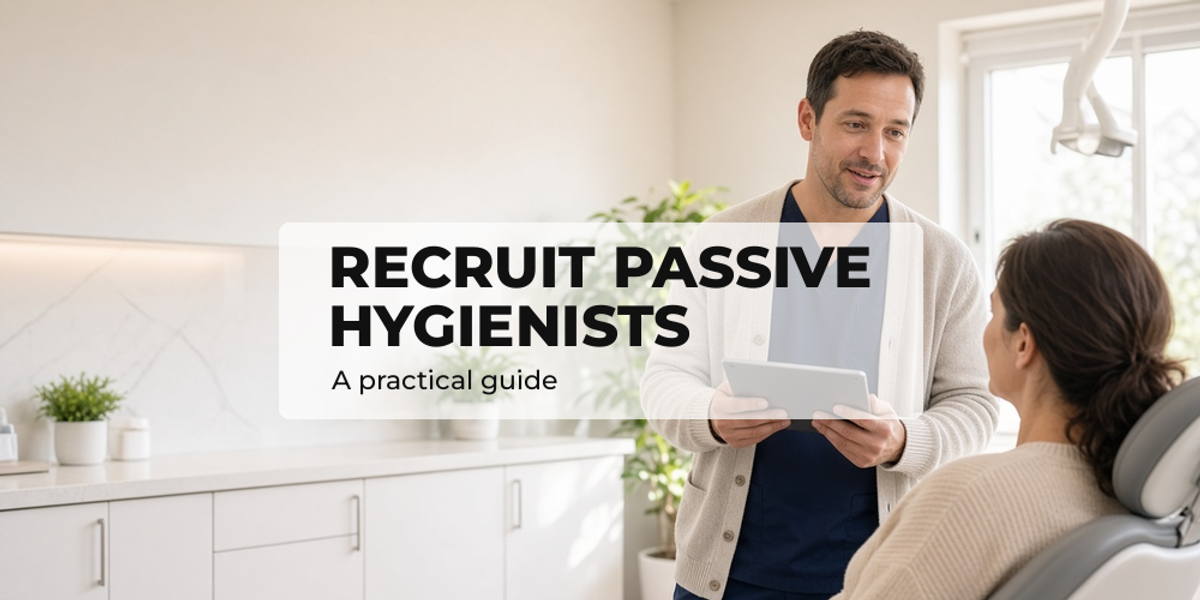
A passive dental hygienist is an employed, licensed RDH who is not running a formal job search. In a tight market, that is most of the workforce. This guide covers what those hygienists actually care about, what they say about recruiter outreach, how to find them, when to reach out, and how to write a first message that has a chance of getting a reply. It also covers follow-up, offers, common mistakes, and a few compliance basics for texting. Keep a public job post up for people who are looking. Direct outreach is how you reach the people who are not.
Key takeaways
- Most good hygienist candidates are employed and not applying. The Bureau of Labor Statistics counted 225,300 dental hygienist jobs in 2025, with 94% in dentists' offices, and projects 8% growth from 2025 to 2035, with about 15,000 openings a year. In the ADA Health Policy Institute's third quarter 2026 poll, 35.1% of private-practice dentist respondents had recruited a hygienist in the prior three months, and 88.3% of those dentists called it very or extremely challenging.
- Passive hygienists do not move for a vague "opportunity." They move when the days, appointment length, patient load, pay, benefits, and office culture are clearer, and better, than what they have.
- Put the details in the first message: the office and city, the days and hours, appointment length, pay range, benefits, and whether the role is W2. Then follow up once if you get no reply, and stop when they ask you to stop.
- Keep a job post live for active seekers, and use direct outreach to licensed dental hygienists for the ones who will never see it. Book a demo or get started free.
What employed hygienists actually care about
If you want a reply from someone who is not looking, the message has to be about the work, not about your vacancy. Schedule, patient load, perio and production pressure, pay, benefits, and culture come up again and again. A 2022 report from the ADA Health Policy Institute, produced with the American Dental Hygienists' Association and other partners, tied retention to work-life balance and workplace culture, and tied leaving to negative culture, insufficient pay, weak benefits, and feeling overworked (ADA and ADHA, October 2022). The report is older than the 2026 hiring poll, but the same themes still show up in how hygienists describe a job worth taking.
Schedule and days per week. Many hygienists work part time, and some work in more than one office, because a practice may only need coverage a few days a week (BLS). A three-day or four-day week, predictable hours, and a clear stance on evenings and weekends can be the reason someone takes a call. "Full time" is not specific enough. Say the days, the start and end times, and whether the schedule is fixed or rotates.
Patient load per hour. Appointment length is often the first clinical question a hygienist will ask. Adult recare visits are commonly scheduled in 60-minute blocks in many offices, with longer visits for new patients or scaling and root planing, but some practices run shorter, higher-volume days. If your hygiene schedule is accelerated, say so in the first message. If documentation is expected inside the appointment, say that too. A hygienist who is not looking will not get on a call to discover they would be seeing a patient every 40 minutes.
Perio and production pressure. Hygienists want to know whether the dentist will support periodontal treatment plans, or whether perio findings get ignored in favor of keeping the recare column full. Production bonuses can be fine when the clinical standard is clear. They become a reason to stay away when the pressure is to meet a number at the expense of the patient in the chair. If you have a hygiene production goal, put it in writing and explain how perio, recare, and doctor exams fit together.
Pay and benefits. The May 2025 median wage for dental hygienists was $98,100, or $47.16 an hour. The lowest 10 percent earned less than $74,880, and the highest 10 percent earned more than $126,050 (BLS). Pay varies widely by market, and some offices use a daily rate instead of an hourly wage. Benefits matter as much as the rate. The 2022 ADA and ADHA report found that dental benefits, paid holidays, paid vacation, and retirement savings were common, while health insurance, paid sick time, and continuing education funds were much less so. If you offer health insurance, paid time off, or a CE allowance, lead with that. If you do not, do not imply that you do.
Office culture. Culture here is practical, not a slogan. Hygienists notice whether the dentist backs them up with patients, whether instruments and software work, whether they have assistant support when they need it, and whether the team is stable or constantly short-staffed. A referral from a current hygienist is often the best proof. If your own team would not recommend the job to a friend, fix the job before you start outreach.
What hygienists say about recruiter outreach
Hygienists are recruited constantly, and they can tell a real role from a template. The pattern is not complicated. Vague outreach feels like a bad job. Stacked texts, emails, and voicemails in the same day feel like harassment. Outreach that ignores a "no" burns the next opening.
In r/DentalHygiene, the useful posts are usually hygienists talking to each other, not to recruiters. In a thread about finding trustworthy job information, a newer hygienist asked where to get reliable pay and office information, said they were not sure they trusted Indeed, and described Facebook groups as a possible source and also as a needle in a haystack. That is one post, not a survey, but it is a good reminder: people want specifics they can trust, and they are wary of listings that do not provide them.
The subreddit is a poor place to recruit. Use it to learn, not to pitch. One short, specific message, sent during business hours, with an easy way to decline, is the version that still gets read.
How to find passive dental hygienists
Start with people who are already licensed to do the work, then narrow to the ones who can actually work in your market and get to your office.
State licensure data and NPI records. A state dental board license list tells you who can legally practice. The National Provider Identifier (NPI) registry can add practice location. Together they are a better starting point than a resume database, because most employed hygienists have not posted a resume. Check the license status, and check any extra permits your role requires, such as local anesthesia or nitrous oxide, because those rules vary by state.
Licensure has a wrinkle. The Dentist and Dental Hygienist Compact is meant to let a hygienist practice in other member states with a compact privilege instead of a second full license. As of May 13, 2026, 13 states had enacted it, with Oklahoma the most recent, but the Compact Commission is still building the data system needed to issue privileges. A license in a member state is not, by itself, permission to work in yours (CSG compact page; Oklahoma enactment notice).
LinkedIn. LinkedIn is useful when hygienists actually use the platform. Many do not keep an active profile, and titles vary ("RDH," "dental hygienist," "registered dental hygienist"). A quiet search often means your candidates are not on the platform much, not that the market is empty.
ADHA and state associations. A post on the ADHA CareerCenter can reach hygienists who already use the association. State dental hygiene associations run CE, newsletters, and local meetings, and some share job listings with members. ADHA27, the association's annual conference, is scheduled for October 15 to 17, 2027, in Phoenix, Arizona (ADHA27). A meeting can help you meet people, but it will not replace outreach for vacancies that open later.
Referrals. If you already employ hygienists, dentists, or assistants, ask them. A trusted introduction is often the fastest path to a candidate who will take the call. Ask specifically ("Do you know an RDH who might want three days a week and 60-minute recare appointments") rather than sending a generic request. The ranked guide to recruiting dental hygienists covers referrals, job boards, temp apps, and the other traditional channels in more detail.
In-market signals. A name on a roster is not a lead. Hygiene students, newly licensed clinicians, and people who already live in the commuting area are often more willing to talk than a license holder two counties away. Expa starts with licensed hygienists in your market, using licensure data from state boards and other practice data such as NPI records, then looks for signs that someone may be open to a conversation.
When to reach out
You can contact employed hygienists at any point in the year. Private practices, groups, and clinics hire throughout the year, and a resignation can empty a chair with very little notice. Waiting until the schedule is already dark usually means you are competing with every other office that just lost someone too.
New graduates are often hired quickly after licensure, so a search that starts after graduation is a common miss. Build a relationship with local programs earlier, and be ready to talk about mentorship, appointment length, and pay. Expa's guide to hiring dental hygienists covers what to prepare.
CE meetings and ADHA27 (October 15 to 17, 2027, in Phoenix) can be natural moments to follow up with people you have already met. They are not a reason to pause outreach the rest of the year.
A good rule is to start earlier than the start date. Passive outreach works poorly when it is a last-minute attempt to replace a job post that went quiet.
How to write a first message that gets replies
Write like a person, and put the facts up front. The first message should answer the questions a busy hygienist would otherwise have to get on a call to ask: who you are, the office and city, the days and hours, appointment length, pay range, benefits, and whether the role is W2. If the office is a private practice, a group, or a DSO location, say that. Leave a clean way to say no.
Keep it short. One channel is enough for the first touch. Do not send the same person a text, an email, and a voicemail in the same afternoon. Do not use subject lines like "exciting opportunity," and do not ask for a call before you will share pay or appointment length.
Here are three short examples. Swap in real details, and do not send them as a blast to a list.
Text
Hi Maya, this is Jordan at [practice] in [city]. We have a W2 hygiene opening, Monday through Thursday, 8 to 5, with 60-minute adult recare appointments, pay $XX to $XX per hour, health insurance and paid time off. If it is not a fit, no need to reply. Happy to email the details if useful.
Subject: RDH role in [city], Mon to Thu, 60-minute recare, $XX to $XX
Hi Maya,
This is Jordan at [practice] in [city]. We are hiring a W2 registered dental hygienist for Monday through Thursday, 8:00 a.m. to 5:00 p.m., with 60-minute adult recare appointments and longer visits for perio. The pay range is $XX to $XX per hour, and the role includes health insurance, paid time off, and a CE allowance.
If you are not looking, feel free to ignore this. If the days or the appointment length are a better fit than what you have, the job description is an easy next step. If not, there will not be another follow-up.
Thanks, Jordan
Hi Maya, your profile mentions hygiene work in [area]. We have a W2 opening at our [city] office, four-day week, 60-minute recare appointments, $XX to $XX per hour, with health insurance and paid time off. If you are content where you are, feel free to ignore this. Happy to send the description if useful.
The common thread is respect. Give them enough to decide, and permission to ignore you.
Follow-up cadence
If they reply, answer the question they asked. Do not force a call if a sentence in writing will do.
If they do not reply, one short follow-up after several business days is reasonable. Restate the role in one or two lines, and close the loop if they would rather not hear from you. Then stop. A third or fourth message, or a switch to calling and texting the same week, is what employed clinicians are trying to avoid.
If they say they are happy where they are, thank them and leave the door open without lingering. A single check-in several months later, with a new and specific role, is more reasonable than a drip campaign. If they ask to be removed, remove them, and make sure the rest of your team does too.
What to offer
The offer is not a sign-on bonus by itself. The offer is a job that is easier to do well than the one they have.
Be ready to talk about days, hours, appointment length, patient load, perio support, pay, and benefits that actually matter, such as health insurance, paid time off, retirement contributions, and continuing education. If the doctor supports perio treatment, say how. If the schedule is four days with no evenings, say so. If the production target has grown past what you will put in writing, fix that before you start outreach.
For new graduates, the mentorship plan is part of the offer, including who precepts and how long new-patient or perio visits will be while they ramp up. For any role, have the pay range and the employment type ready on the first exchange, not after a screening call.
Mistakes to avoid
- Writing to "hygienists in the area" with no days, no appointment length, and no pay
- Stacking a call, a text, and an email, then following up the next day
- Refusing to put pay, benefits, or appointment length in writing
- Contacting someone about a role they cannot do, such as the wrong state license or a missing anesthesia permit
- Treating a license in a Compact member state as automatic permission to work in yours, without checking whether a privilege has been issued
- Pitching a new-grad role with no mentor and a full, accelerated schedule on day one
- Waiting until the chair is already empty, then expecting a hired hygienist in a few days
- Ignoring a request to stop, or letting another recruiter on your team start over
- Overselling the job, then shortening appointments or raising production after the person starts
A few compliance basics for texting
Texting can be a good channel because it is short and easy to answer. It is also regulated. In the United States, the Telephone Consumer Protection Act (TCPA) and Federal Communications Commission rules can apply to texts, especially when messages are sent with automated tools. The details depend on how you got the number, what the message says, and how it is sent, and those rules change. This is not legal advice.
A practical baseline is enough to keep you from being careless. A license list, an NPI record, or an old resume is not automatically permission to text. Identify yourself and the employer in the first message, keep the text about a specific role, and honor "stop" or "not interested" quickly, including across your team and your vendor. Keep records of how you obtained a number and of any consent you were given. If you are not sure you have a lawful basis to text, use email or LinkedIn until counsel or your outreach vendor has reviewed the campaign. Across channels, be identifiable, be specific, and stop when they tell you to stop.
How to do this without building it by hand
You can do this work with a license list, a spreadsheet, and a disciplined recruiter or office manager. Many teams do not have the time. The searching, the personalization, and the follow-up are what stall a manual search.
Expa is built for that part. You describe the role. It builds a pool from state licensure data and practice records, looks for in-market signals, and runs outreach over text, email, and LinkedIn. Emails go out from your recruiter's own Gmail or Outlook inbox. You see the shortlist before anything is sent, nothing goes out until you launch it, and anyone you remove is not contacted. Interested candidates can be screened and booked onto your calendar. A search takes about ten minutes to start, and Expa is built to return a slate of interested, contactable candidates within 48 hours, often within 24. For groups and DSOs, searches can be run around each office so the shortlist matches that commute. It does not replace your team. It takes the chasing off their plate so they can talk to people who already replied.
If you want to source dental hygienists who are not on job boards, book a demo or get started free.
Conclusion
Passive hygienist recruiting is not a secret script. It is a specific job, sent to a licensed RDH who can actually do it, with enough detail to decide and enough respect to decline. Keep a public post up for people who are looking. For everyone else, start with hygienists already practicing in your area, write a short message that names the days, appointment length, pay, and benefits, follow up once, and stop when you are asked to stop. Start earlier than the start date, especially for new graduates, and make sure the job you described is the job they will walk into.
FAQ
What is a passive dental hygienist?
A passive dental hygienist is a licensed RDH who is already employed and is not actively applying to jobs. They may still be open to a conversation if the schedule, appointment length, pay, or culture is a genuine improvement.
Is it appropriate to contact hygienists who are not job hunting?
Yes, if you are specific, honest, and easy to decline. Hygienists object to being spammed, misled, or boxed into a call, not to a single factual message about a real role. If they say no, or ask to be removed, stop.
Should we text, email, or use LinkedIn first?
Use one channel first. Email is usually the easiest place to include appointment length, pay, and benefits. Text is shorter and easy to answer, but it has tighter consent rules. LinkedIn works when the hygienist is actually on the platform. Do not stack all three in the same day.
How often should we follow up?
Once is enough if they have not replied, after several business days. If they are not interested, stop. A later check-in is more reasonable when you have a new, specific opening and several months have passed. Immediate, repeated follow-up is what people complain about.
How can Expa help us reach employed dental hygienists?
Expa finds in-market dental hygienists from licensure and practice data, runs the outreach over text, email, and LinkedIn, and brings you the people who are interested. Your team approves the shortlist and spends its time on conversations, not on building the list.